The Schoolmaster Who Proposed America's Time Zones
Saratoga Springs, New York. Saturday evening, the twelfth of November, 1904. Local accounts place a seventy-nine-year-old man at the grade crossing on North Broadway. A Delaware and Hudson train is coming.
He was a retired schoolmaster named Charles F. Dowd. Almost twenty-one years earlier, America's railroads had reset their clocks at noon, to a new kind of time. Hour-wide time zones. Two days later, The Sun of New York reported that he had been "killed by a Delaware and Hudson Railroad train at a grade crossing". The schoolmaster had proposed time zones first. The railroads turned him down. A decade later, they adopted the same principle in another man's plan, one that Dowd himself fought on one point. This is the story of why America has time zones. And of what the man who proposed them got in return.
Out on the rail lines, time was a tangle. Every town kept its own time, set by the sun. Noon came when the sun stood highest, and that moment came a little later with every few miles west. Dowd's 1870 pamphlet, as the historian Ian Bartky quotes it, said a traveller who left home could no longer trust his own watch. Bartky adds that Dowd exaggerated. Most travellers just asked what time the station kept. The railroads had a tangle of their own. One railroad man, William F. Allen, would later count forty-nine railroad times in use. Remember his name.
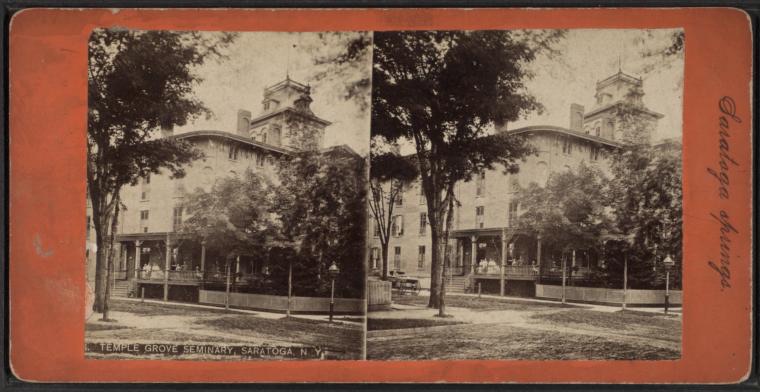
Dowd was a Yale man and a clergyman. In 1868 he bought Temple Grove, in Saratoga Springs, and he and his wife, Harriet, ran its school for young women together.

Dowd did the arithmetic. He began with one time for the whole country. Then he worked out its difference from local time in about eight thousand places. The gaps ran up to almost four hours. Railway managers convinced him that a gap of more than an hour would not work. Business, he said later, was tied to local time: "no one time would do". The answer was zones. Each one an hour wide.
In October 1869, by his own later account, he took his plan to a New York convention of major railroads. It named six superintendents to confer with him. We found no record of that meeting from 1869. We have only his word. In 1870 he printed the plan, a pamphlet of over a hundred pages. It showed four zones, an hour apart, measured from Washington's time. It came with a coloured map. It also kept local time for the cities, so a few cities would have kept three times at once: their own and two railroad times.
He kept going back to the railroads: in 1871, and again in 1872. By then he measured his zones from Greenwich, in England, instead. In April 1872, in Atlanta, the Western and Southern Railway Association heard a committee report. It recommended "the system devised by Mr. Chas. F. Dowd, of Saratoga, New York", with some changes. The Railroad Gazette reported that the recommendation "seemed to meet with general favor". It looked as if he had won.
Then came 1873. The railway associations shelved the plan. They put off the whole question of national railroad time until the public clearly called for it. That May, a New York paper reported there was no public demand. The railroads, Bartky writes, rejected a plan that was the same in principle as the one they would adopt a decade later. Then they forgot it. And they forgot Dowd as well.
Around 1877 or 1878, Dowd drew a new plan with just two zones. Its dividing line followed the rail lines. It ran almost exactly where the 1883 line between eastern and central time would fall.
Meanwhile, others were moving to take charge of time. In 1881, Connecticut made New York City's time the state standard. That December, the Navy's observatory had a bill put before the House, for Washington time in official use. Scientists were pressing governments too, and a time could soon be imposed on the railroads from outside.
Bartky credits Allen with getting the railroads to act first. Allen's plan had five standards, each an hour apart, measured from Greenwich. Its boundaries fell at railway terminals and division points. On the eleventh of April, 1883, in St. Louis, the railroads' General Time Convention adopted it. The principle was Dowd's. Zones an hour wide.
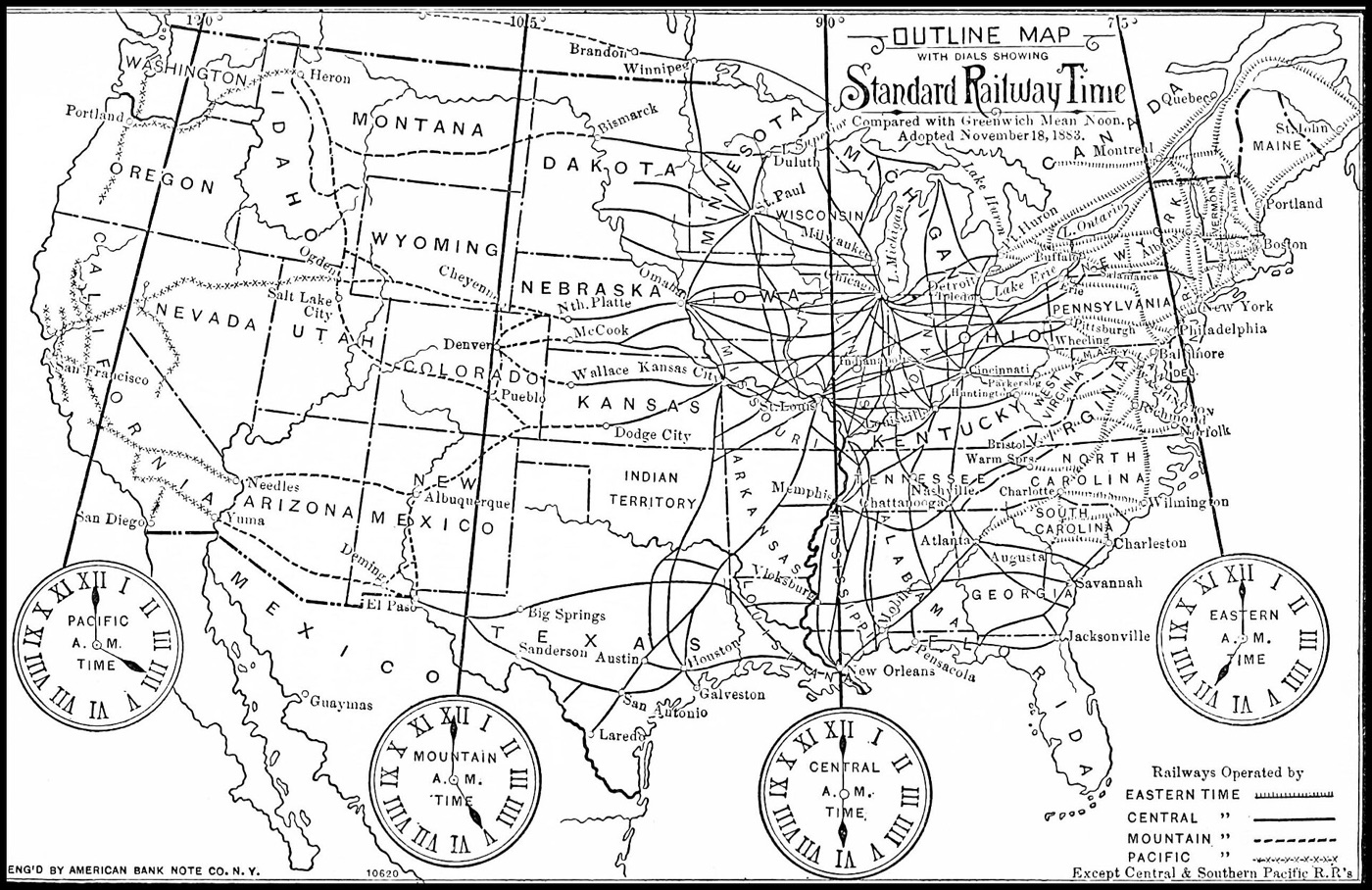

But one thing was not. Dowd wanted towns to keep their own local time beside railroad time. Allen's plan abolished it. That year, Dowd argued that abolishing local time could not, and should not, be done. He lost that argument.
In October, the convention met again, in Chicago. It set the switch for noon on Sunday, the eighteenth of November. It called the plan "the hour system".
That Sunday, Allen watched from the roof of the Western Union Building in New York. The bells of St. Paul's struck noon by the old time. New York was setting its clocks back four minutes. Four minutes later, the time-ball, a public time signal, dropped. Noon, again. Writers called it the day of two noons. The next morning, the New-York Tribune reported: "There was a general re-setting of clocks and watches in this city yesterday".
On the same page, it named the man behind the idea. "The principles of the system were first publicly suggested by Professor Charles F. Dowd." But a second paper had already said otherwise. Three days earlier, the Railroad Gazette, the industry's own paper, had given the credit to Allen. It said the early proposals, Dowd's among them, had had "apparently no effect". But the Gazette had a stake. One of those early proposals was its own. Dowd's credit was not lost. It was contested.
The new time was contested too. In Chicago, people stopped their clocks for nine minutes, but the city itself did not adopt the new time until December. Savannah tried it, then gave it up. Detroit refused it and stayed on local time. Pittsburgh held out until the first of January, 1887. On that point, the schoolmaster had company.
What did he get for all of it? For years, the railroads gave him annual passes. The Sun's obituary put it plainly: "But that's all he ever did get". He had hoped to sell his system. But all he could protect was the copyright on his writing. Until his death, The Sun said, he was working on a twenty-four-hour international time system.
Then came that Saturday evening at the crossing. Until 1918, standard time had no national law behind it. That year, a wartime law said the country would be "divided into five zones". Dowd did not live to see it. But the idea a schoolmaster first put to the railroads had become law.
Sources
- The Sun (New York), November 14, 1904, page 5, "Standard Time His Hobby" (Library of Congress): https://www.loc.gov/resource/sn83030272/1904-11-14/ed-1/?sp=5
- New-York Tribune, November 19, 1883, page 2, "Time Standards Changed" (Library of Congress): https://www.loc.gov/resource/sn83030214/1883-11-19/ed-1/?sp=2
- Railroad Gazette, May 25, 1872, report of the Western and Southern Railway Association meeting in Atlanta (Internet Archive): https://archive.org/details/sim_railway-age_1872-05-25_4
- Railroad Gazette, November 16, 1883, "Time for the Continent" (Internet Archive): https://archive.org/details/sim_railway-age_1883-11-16_15
- Ian R. Bartky, "The Adoption of Standard Time", Technology and Culture, volume 30, number 1, January 1989, pages 25 to 56: https://zenodo.org/records/1235142
- Nathaniel Bartlett Sylvester, "History of Saratoga County, New York" (1878) (Internet Archive): https://archive.org/details/historyofsaratog00sylv
- Anderson and Farnham, "Our County and Its People: Saratoga County" (1899) (Internet Archive): https://archive.org/details/ourcountyitspeop00ande
- "An Act To save daylight and to provide standard time for the United States", approved March 19, 1918, United States Statutes at Large, volume 40 (Internet Archive): https://archive.org/details/sim_united-states-united-states-statutes-at-large_april-1917-march-1919_40
Picture shown with this story in the list of stories: Wood engraving of Charles F. Dowd, 1883, Library of Congress. Public domain, via Wikimedia Commons.
